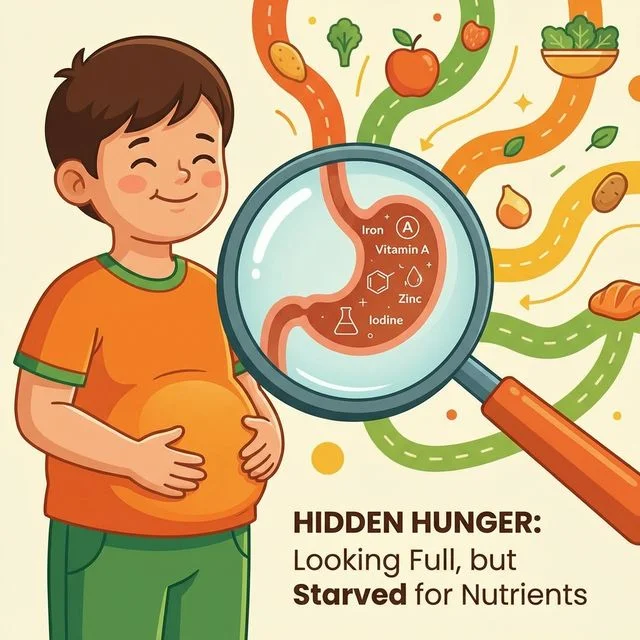
Hidden Hunger: Why Your 'Healthy' Child Might Be Overfed But Undernourished
Imagine this scenario: Your 6-year-old child eats three full meals a day. They love their rice, they enjoy their evening biscuits, and they never skip dinner. They are gaining weight normally, perhaps even a bit chubby.
You pat yourself on the back. My child is well-fed.
But when you visit the pediatrician, the diagnosis leaves you shocked: Anemia. Vitamin D deficiency. Poor immunity.
"But doctor," you might say, "My child eats so much!"
This paradox—where a child consumes enough (or too many) calories but starves for essential vitamins and minerals—has a name. It's called Hidden Hunger. And according to the latest national data, it is the single biggest nutritional threat facing urban Indian children today.
Key Takeaways
- Hidden Hunger is invisible: a child can look healthy or even chubby while critically short on micronutrients like iron, zinc, and vitamin D.
- It's a "white food" problem: carb-heavy diets of rice, refined flour, and biscuits fill the tummy but leave the cells hungry.
- Watch the behaviour, not just the plate: poor focus, restless sleep and frequent illness are common silent signs.
- The fix is nutrient density: a "rainbow plate," millets, and smarter snacks can bridge much of the gap without any pills.
What is Hidden Hunger?
Hidden Hunger (Micronutrient Deficiency) is unlike the hunger we see in poverty. It doesn't look like starvation. There are no hollow cheeks or visible ribs.
In fact, children suffering from hidden hunger often look completely "normal" or even overweight. They are getting plenty of macronutrients (carbohydrates and fats) which provide energy (calories). But they are critically lacking in micronutrients (vitamins and minerals) which act as the "software" that runs their body.
The Scary Statistic: Recent estimates suggest that nearly 80% of Indian adolescents suffer from at least one form of hidden hunger.[1]
In urban South India, where diets are often calorie-rich but nutrient-poor, this number is alarmingly high even among affluent families.
The "White Food" Trap: Why It Happens
The primary culprit is what nutritionists call the "Calorie-Nutrient Mismatch."
Take a look at a typical day for many urban kids:
- Breakfast: Idli or Dosa (Rice/Lentil batter)
- Lunch: White Rice with Sambar
- Snack: Biscuits or Chips (Refined Flour)
- Dinner: Rice or Chapati
While delicious, this diet is heavily skewed towards Carbohydrates.
- Calories: High (100% met)
- Zinc, Iron, Calcium: Low (< 50% met)
The stomach is full, but the cells are hungry.
The "Double Burden" of Malnutrition
We are essentially overfeeding our children's energy systems while underfeeding their growth systems. This leads to the "Double Burden": a child who is simultaneously at risk of obesity (from excess carbs) and stunted development (from lack of zinc/iron).[2]
3 Silent Signs of Hidden Hunger
Since you can't "see" a vitamin deficiency easily, look for these subtle behavioral cues.
1. The "Tired & Wired" Syndrome (Iron Deficiency)
Iron is essential for carrying oxygen to the brain. When levels drop, a child becomes irritable, has trouble focusing in school, or feeling exhausted after minimal physical activity. Learn the 5 silent signs of iron deficiency every parent should watch for.
- Prevalence: Nearly 49% of urban school children have some form of iron deficiency.[3]
- The Sign: Rubbing eyes frequently, "boredom" during homework, or pale fingernails.
2. Growing Pains & Poor Sleep (Magnesium/Calcium Gap)
Magnesium is the "relaxation mineral," and Calcium builds bones. A deficiency often manifests as "growing pains" in the legs at night or restless sleep.
- Prevalence: In some South Indian cities, Calcium deficiency affects up to 60% of children.[3]
- The Sign: Waking up at night complaining of leg pain, or generally restless sleep.
3. Frequent Sick Days (Zinc/Vitamin A Gap)
If your child catches every cold that goes around school, their "shield" might be down. Zinc and Vitamin A are critical for immune defense.
- The Sign: A cold that lasts 10 days instead of 3, or recurring skin rashes.
At a glance, here's how those three silent signs map to the likely nutrient gap:
| Silent Sign | Likely Nutrient Gap | What You Might Notice |
|---|---|---|
| Tired & wired, poor focus | Iron | Rubbing eyes, "boredom" at homework, pale nails, tiring quickly |
| Growing pains & restless sleep | Magnesium / Calcium | Night-time leg pain, waking often, restless sleep |
| Frequent sick days | Zinc / Vitamin A | Colds that drag on for days, recurring skin rashes |
The Data: It's Not Just Your Child
The Comprehensive National Nutrition Survey (CNNS), conducted with UNICEF, shed light on just how widespread this is in urban India.[1]
| Micronutrient | Deficiency Prevalence (Urban India) | Impact on Child |
|---|---|---|
| Vitamin D | ~40% - 60% | Weak bones, low immunity, mood swings. |
| Iron | ~30% - 49% | Reduced IQ, poor concentration, fatigue. |
| Vitamin B12 | ~33% | Nerve health, energy levels, memory. |
| Folate | ~23% | Cell growth, red blood cell formation. |
Data compiled from CNNS and recent multi-center studies in Indian cities. [1][3]
This isn't a "rural" problem. It is an "urban" problem caused by lifestyle and diet choices.
How to Fight Hidden Hunger: The "Rainbow Plate" Strategy
The antidote to Hidden Hunger is Nutrient Density. We need to make every bite count.
1. Break the "White" Monotony
If a meal is entirely white or beige (Rice, Bread, Potato), it is a red flag. Aim for 3 colors on the plate.
- Add Green: Curry leaves powder (karivepaku podi) or spinach in dal.
- Add Orange: Carrots, pumpkin, or papaya.
- Add Red: Beetroot or Pomegranate.
2. Revival of Millets
Millets are the original "anti-hidden-hunger" crops.
- Sorghum (Jowar): Rich in Zinc.
- Pearl Millet (Bajra): Incredible source of Iron (8mg/100g vs 3.5mg in Wheat).
- Finger Millet (Ragi): The Calcium King.
Swapping just one meal or snack from Wheat/Rice to Millets can bridge 50% of the nutrient gap.
3. Smart Supplementation (Food First)
Before reaching for pills, look at your pantry.
- For Iron: Jaggery, Dates, Garden Cress Seeds (Aliv).
- For B12: Curd/Yoghurt (essential for vegetarians), Fortified foods.
- For Vitamin D: 20 mins of sunshine, Mushrooms, Egg yolks.
4. The 25% Rule for Snacks
Since snacking makes up 25% of calories, it must provide 25% of nutrients. Stop treating snacks as "fillers." A Rise Kids cookie made of Ragi, Almonds, and Jaggery isn't just a treat; it's a dose of Calcium, Vitamin E, and Iron that fights hidden hunger.
Fullness Is Not the Same as Fuel
The single biggest mindset shift for beating hidden hunger is this: stop measuring a meal by whether it fills the tummy, and start measuring it by what it gives the body. A bowl of instant noodles keeps a child full for hours but delivers almost no vitamins or minerals. Before you reach for a snack, it's worth asking one simple question — "What did this actually give my child's body?" If the honest answer is "just calories," that's hidden hunger in the making.
Frequently Asked Questions
Can a child be overweight and undernourished at the same time? Yes — that's the heart of Hidden Hunger. A carb-heavy diet delivers plenty of calories (leading to weight gain) while falling short on the vitamins and minerals cells actually need. This "double burden" means a child can be simultaneously at risk of obesity and stunted development.
Is Hidden Hunger only a problem in poorer families? No. It's largely an urban and lifestyle-driven issue. National surveys have found high micronutrient deficiency rates even among affluent families whose children eat plenty — because their diets lean heavily on refined, "white" foods rather than nutrient-dense ones.
How can I tell if my child has Hidden Hunger? You often can't see it, so watch the behavioural cues: poor concentration, tiredness after little activity, restless sleep or leg pains, and frequent, lingering illnesses. These are clues, not a diagnosis — a pediatric blood test is the only way to confirm a specific deficiency.
Do millets really help? They're one of the simplest fixes. Millets like bajra (iron), jowar (zinc) and ragi (calcium) are far more nutrient-dense than refined wheat or rice. Swapping just one meal or snack to millets can bridge a meaningful share of the daily nutrient gap.
Should I give my child supplements? Try food first. Iron from jaggery and dates, B12 from curd, and vitamin D from sunshine and egg yolks go a long way. Reserve supplements for confirmed gaps, ideally on a doctor's advice, rather than using them as a default.
Conclusion
Hidden Hunger is scary because it is silent. But the power to fix it is in your hands—and in your kitchen.
It starts with small swaps. It starts with reading labels. It starts with refusing to accept that "kids will be kids" and eat only junk. By choosing nutrient-dense foods like millets, nuts, and natural sweeteners, you are essentially "supplementing" your child's diet naturally.
Let's ensure our children aren't just growing bigger, but growing stronger. Let's feed them, not just fill them.
When you want a snack that fights Hidden Hunger instead of feeding it, our Rise Kids range is built on nutrient-dense millets, nuts, and natural sweeteners — so every bite counts.
References & Scientific Sources
- Ministry of Health and Family Welfare (MoHFW), Government of India, UNICEF and Population Council. "Comprehensive National Nutrition Survey (CNNS) National Report 2016-2018." https://www.unicef.org/india/reports/comprehensive-national-nutrition-survey-2016-2018
- Global Hunger Index. "India Ranking & Key Findings 2024/2025." https://www.globalhungerindex.org
- PLOS ONE Study. "Micronutrient deficiencies in urban school-going children in India." PLOS ONE, 2021. https://journals.plos.org/plosone/article?id=10.1371/journal.pone.0252522
- National Family Health Survey (NFHS-5), 2019-21. "India Fact Sheet." International Institute for Population Sciences.
- Gonmei, Z., et al. "Double burden of malnutrition among Indian children and adolescents." The Lancet Child & Adolescent Health.

Snacks that pull their nutritional weight.
Put the 25% Rule into practice — millet snacks engineered to deliver real nutrients, not empty calories.
Start here
The 25% Rule: Why Your Child's Snacks Should Match Their Nutritional Needs
Did you know 25-30% of your child's calories come from snacks? Discover the '25% Rule'—a science-backed guide to ensuring those bites build bones, immunity, and brain power.

The 25% Rule: Why Your Child's Snacks Should Match Their Nutritional Needs
Did you know 25-30% of your child's calories come from snacks? Discover the '25% Rule'—a science-backed guide to ensuring those bites build bones, immunity, and brain power.
Decoding RDA: What Recommended Dietary Allowances Really Mean for Your Family
RDA, EAR, UL? Confused by nutrition acronyms? We break down the science of Recommended Dietary Allowances and how to use them to ensure your child isn't just surviving, but thriving.

The Ultimate Guide to Essential Nutrients for Growing Kids: What Every Parent Needs to Know
Unlock the secrets of childhood nutrition. A comprehensive deep dive into the 7 essential nutrients that fuel your child's growth, brain development, and immune system, backed by the latest RDA standards.
Share this knowledge
Help other parents raise healthy champions!