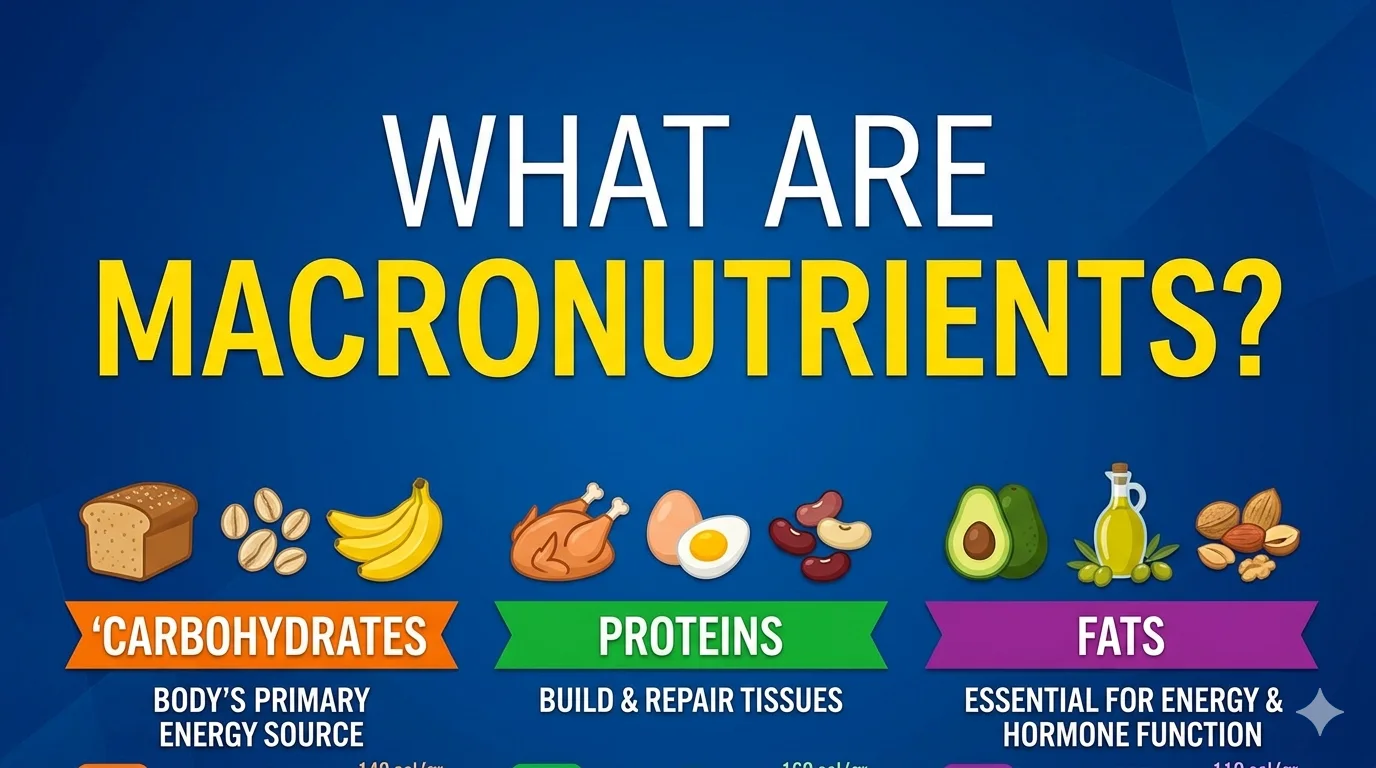
And Why Do Kids Need All Three?
Every time you feed your child, you are giving them one or more of three fundamental building blocks of nutrition. These are called macronutrients — and understanding them is the single most useful thing a parent can learn about food.
Macronutrients are nutrients the body needs in large amounts to function. Unlike vitamins and minerals — which are needed in tiny doses — macronutrients are the structural and fuel components of everything your child eats. There are three of them: protein, carbohydrates, and fat.
Every credible nutrition authority on the planet agrees: children need all three, at every meal, in the right proportions. No macro is the enemy. No macro should be avoided. The problems arise only when one dominates at the expense of the others — or when the quality of a macro is poor.
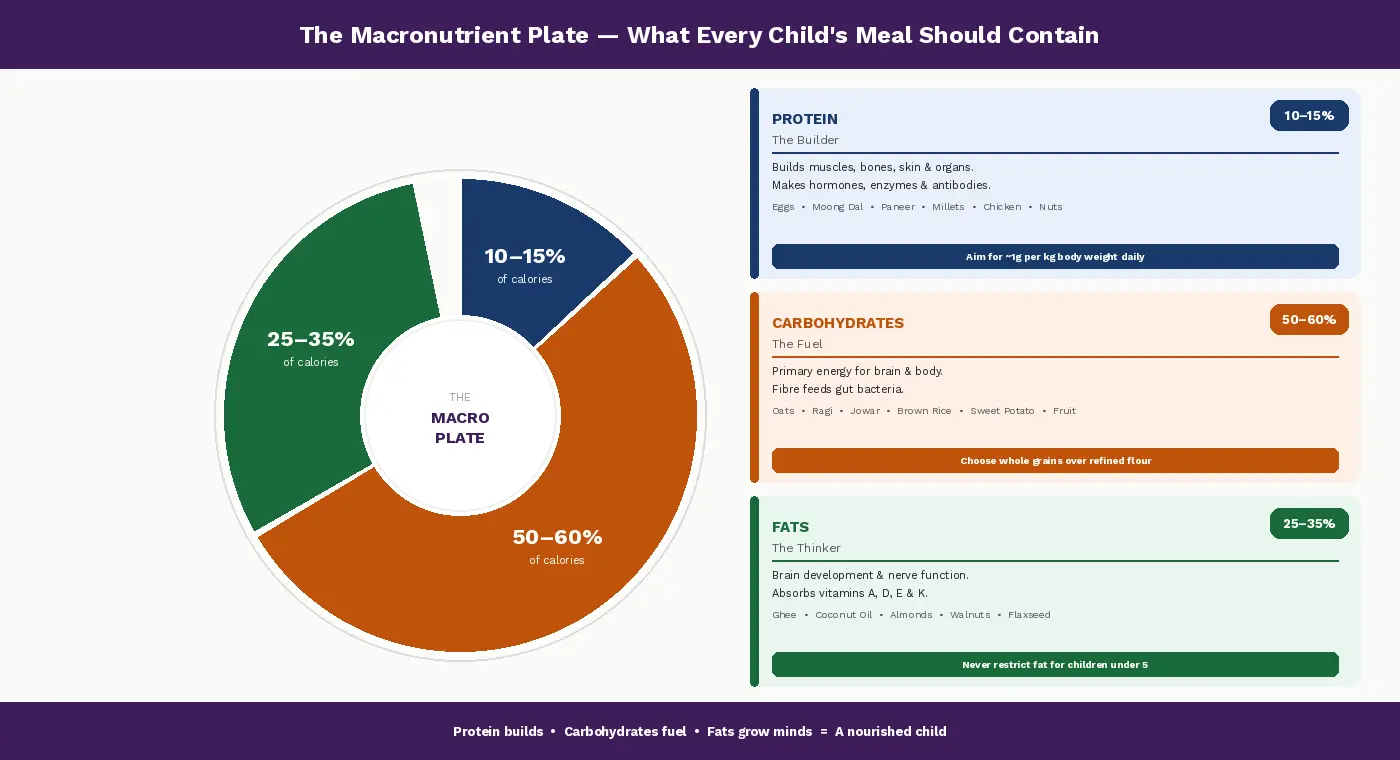
The three macronutrients — their roles, food sources, and daily requirements for children.
Key Takeaways
- Children need all three macronutrients — protein, carbohydrates, and fat — at every meal; none is the enemy.
- Protein builds and repairs the body, carbohydrates are its preferred fuel, and fat protects the brain and enables vitamin absorption.
- With carbohydrates the problem is almost never quantity but quality — refined flour and sugar crash blood sugar where whole grains and millets sustain it.
- The easiest way to apply the balance is to build every snack on all three macros, rather than counting percentages.
The Three Macronutrients at a Glance
| Macronutrient | Main Role | Best Sources for Kids |
|---|---|---|
| Protein | Builds and repairs muscle, bone, skin, immunity | Eggs, paneer, curd, milk, dal, chickpeas, nuts, millets |
| Carbohydrates | Preferred fuel for the brain and body | Millets, whole grains, legumes, vegetables, whole fruit |
| Fat | Protects the brain, enables vitamin A/D/E/K absorption | Ghee, coconut oil, nuts, seeds, full-fat dairy |
What Is a Macronutrient?
The word 'macro' simply means large. Macronutrients are the nutrients your child's body uses in gram quantities every single day — as opposed to micronutrients like iron or zinc, which are needed in milligrams or micrograms.
Each macronutrient provides calories (energy), but they each do very different things beyond simply fuelling the body. This is why you cannot simply swap one for another. A high-carb, low-protein diet is not nutritionally equivalent to a high-protein, low-carb diet with the same calorie count. The body responds to the composition of what it eats, not just the total energy.
PROTEIN — The Builder
What it is
Protein is made up of 20 amino acids, nine of which are 'essential' — meaning the body cannot manufacture them and must obtain them from food. These amino acids are the literal raw materials your child's body uses to build and repair virtually every structure: muscle fibres, bone matrix, skin, hair, organs, enzymes, hormones, and antibodies.
When a child grows taller, they are building new protein structures. When they recover from illness, protein repairs damaged tissue. When they feel full after a meal, it is largely because protein triggers satiety hormones more powerfully than any other macronutrient.
Why children need it
- Growth and repair — every centimetre of height requires new structural protein
- Immune function — antibodies are proteins; well-nourished children fight infection more effectively
- Hormonal balance — insulin, growth hormone, and thyroid hormone are all proteins
- Satiety — protein suppresses the hunger hormone ghrelin better than carbs or fat
- Brain function — amino acids are precursors to serotonin, dopamine, and other neurotransmitters
How much do children need?
The Recommended Dietary Allowance (RDA) for protein in Indian children (ICMR-NIN 2020): about 12.5g/day for ages 1–3, 15.9g/day for ages 4–6, and 23.3g/day for ages 7–9. A practical rule: aim for roughly 0.9g of protein per kilogram of body weight for school-age children. A 25kg child needs around 23g per day — achievable with the right diet, but easily missed when snacks are carb-heavy and protein-light.
Best sources for children
- Animal: eggs, chicken, fish, paneer, curd, milk
- Plant: moong dal, chana dal, chickpeas, lentils, tofu, nuts, seeds
- Grains: millets — jowar, ragi, foxtail — contribute meaningfully to daily protein
CARBOHYDRATES — The Fuel
What it is
Carbohydrates are the body's preferred and most efficient energy source. They break down into glucose, which the brain uses exclusively as fuel under normal conditions. Without adequate carbohydrates, the body is forced to use protein and fat for energy — pulling them away from their primary structural and protective roles.
Not all carbohydrates are equal — and this distinction matters enormously for children. Complex carbohydrates from whole grains, legumes, and vegetables come packaged with dietary fibre, vitamins, and minerals. Simple carbohydrates from refined flour, sugar, and ultra-processed snacks are stripped of all of these.
Why children need them
- Primary fuel for the brain — a child's brain uses up to 60% of the body's glucose
- Spare protein — adequate carb intake ensures protein is used for building, not burning
- Fibre — complex carbs feed the gut microbiome and support digestive health
- Sustained energy — whole grain carbs release energy slowly, supporting school-time concentration
- Mood and behaviour — blood sugar stability directly affects a child's emotional regulation
The quality problem
The issue with carbohydrates in children's diets is almost never quantity — it is quality. Most children eat plenty of carbohydrates. But in the average Indian child's snack diet, they come predominantly from maida, white rice, and added sugar — all of which digest rapidly, spike blood glucose, and then crash it.
The blood sugar crash that follows a refined-carb snack triggers cortisol release, irritability, difficulty concentrating, and renewed hunger within 30–45 minutes. This is the cycle that drives the constant demand for 'one more snack.'
Best sources for children
- Millets: jowar, ragi, foxtail millet, little millet, bajra — high fibre, low glycaemic
- Legumes: lentils, chickpeas, moong dal — protein + fibre + slow-release carbs combined
- Vegetables: sweet potato, corn, carrots — nutrient-dense energy sources
- Whole fruits (not juice) — fibre intact, natural sugars buffered
- Whole grains: oats, brown rice — far superior to their refined counterparts
FATS — The Protector
What it is
Dietary fat has been unfairly maligned for decades. The low-fat food movement of the 1980s and 90s did enormous damage — particularly to children's nutrition — by replacing fat with sugar and refined carbohydrates and calling the result 'healthy.'
Fat is essential. The brain is approximately 60% fat by dry weight. Every single cell membrane in the human body is made of a fat structure. Fat is required to absorb the fat-soluble vitamins A, D, E, and K — which govern vision, bone development, immune function, and cellular health. Without adequate fat, these vitamins pass through the body unused.
Why children especially need it
- Brain development — DHA is structurally incorporated into brain cell membranes; deficiency is associated with poorer cognitive outcomes
- Vitamin absorption — fat-soluble vitamins A, D, E, and K cannot be absorbed without dietary fat in the same meal
- Hormone development — cholesterol from dietary fat is the precursor to every steroid hormone, including those governing growth
- Cell integrity — every cell your child grows is wrapped in a membrane made of fatty acids
- Satiety and palatability — fat slows digestion and makes food satisfying, supporting healthy eating behaviour
Best sources for children
- Ghee — rich in fat-soluble vitamins and butyrate, which supports gut health
- Coconut oil — medium-chain triglycerides are rapidly available for energy
- Nuts and nut butters — almond, peanut, cashew provide protein and healthy fat together
- Seeds — flax, chia, and pumpkin seeds are excellent plant sources of omega-3 fatty acids
- Full-fat dairy — curd, paneer, and milk provide fat alongside calcium and protein
Getting the Balance Right
The Acceptable Macronutrient Distribution Ranges for children are: Protein 10–30% of daily calories, Carbohydrates 45–65%, and Fat 25–35%. These ranges are intentionally wide because children's needs vary by age, size, and activity level. What they tell us clearly is that none of the three should be dramatically reduced — all three have meaningful floor requirements below which health is compromised.
In practice, the easiest way to apply this is not to count percentages but to compose meals and snacks that include all three macronutrients together. A snack of plain crackers is mostly refined carbs. Add nut butter and it becomes a carb-protein-fat combination. Add a piece of fruit and you have fibre too. The upgrade requires almost no extra effort — just the awareness of what's missing.
What This Means for Snacks
Snack time is where the macronutrient balance breaks down most severely. Most children eat two snacks per day. If those snacks are exclusively carbohydrate-based — as the vast majority of packaged children's snacks are — then a child is missing meaningful protein and fat contributions from roughly 20–25% of their daily eating occasions.
The impact accumulates. Over weeks and months, a snack diet built on refined carbs with minimal protein and fat contributes to persistent hunger, blood sugar instability, insufficient protein for optimal growth, reduced vitamin absorption, and a gut microbiome deprived of the fibre it needs.
The solution is not complicated. It is simply to choose snacks that are built on all three macronutrients — protein to build, complex carbohydrates to fuel, and fat to protect. Snacks that achieve this are not exotic or expensive. They are just thoughtfully made. This is exactly the thinking behind our millet-based snacks — carbohydrate, protein, and fat working together in one bite.
Frequently Asked Questions
What are the three macronutrients children need? Protein, carbohydrates, and fat. Protein builds and repairs the body, carbohydrates provide its main fuel, and fat protects the brain and helps absorb the fat-soluble vitamins A, D, E, and K. Children need all three at every meal.
Are carbohydrates bad for kids? No. Carbohydrates are the brain's preferred fuel — a child's brain uses up to 60% of the body's glucose. The issue is quality, not quantity: complex carbs from millets, whole grains, and legumes sustain energy, while refined flour and added sugar spike and crash it.
Should I put my child on a low-fat diet? No. Fat is essential for children — the brain is roughly 60% fat by dry weight, and fat is required to absorb key vitamins. The low-fat trend of past decades did real harm by replacing fat with sugar. Focus on healthy fats like ghee, nuts, seeds, and full-fat dairy.
How much protein does a child need? Per ICMR-NIN 2020, roughly 12.5g/day for ages 1–3, 15.9g/day for ages 4–6, and 23.3g/day for ages 7–9 — about 0.9g per kilogram of body weight for school-age children. It's easily met with the right diet but easily missed when snacks are carb-heavy and protein-light.
What's the ideal balance of macros for kids? The Acceptable Macronutrient Distribution Ranges are roughly 10–30% protein, 45–65% carbohydrates, and 25–35% fat. Rather than counting percentages, the practical approach is to build each meal and snack around all three macros together.
The Bottom Line
Macronutrients are not diet concepts. They are the fundamental chemistry of how your child's body works. Protein builds it. Carbohydrates fuel it. Fat protects and enables it. All three are necessary. All three work best together.
The next time you look at a children's snack, ask three questions: Does it contain meaningful protein? Are the carbohydrates complex, or refined? Is there a source of healthy fat? A snack that answers yes to all three is genuinely doing something useful for your child. One that can only answer yes to the middle one — refined carbohydrates — is filling a lunchbox without nourishing the child inside it.
Next in this series: The Ultimate Guide to Essential Nutrients for Growing Kids

Protein in every bite.
Give your child a protein-packed, plant-based snack that helps them grow strong.
Start here
How Much Protein Do Kids Actually Need?
Protein is essential for growth, immunity, and focus, but most children's snacks are surprisingly low in it. Here's what kids actually need by age.
How Much Protein Do Kids Actually Need?
Protein is essential for growth, immunity, and focus, but most children's snacks are surprisingly low in it. Here's what kids actually need by age.
Protein Power: Is Your Vegetarian Child Getting Enough?
Think a bowl of dal is enough protein for your growing child? Think again. Discover the truth about meeting protein needs on an Indian vegetarian diet.
Share this knowledge
Help other parents raise healthy champions!